A 5G uplink for every robot, in every environment, in the same GPU step.
Isaac-Net is a GPU-batched 5G network engine that advances the 5G NR uplink of thousands of parallel Isaac Lab environments one scheduling slot at a time, in lockstep with physics, so a robot fleet trains against the queues, retransmissions and contention it creates itself.
1,048,576 robots on one RTX 40901.24 control steps/s with the validated NR uplink40 uplink slots per 100 ms control stepi.i.d. delay to 3GPP NR behind one API
At a glance
Three pillars
one GPU
A batched engine on one GPU
Every piece of network state is a fixed-size tensor with leading dimensions [envs, robots], and a single Triton kernel runs all 40 uplink slots of a control step in one launch.
1.97 msNR network step at 256 × 16 on triton, uplink only, idle GPU
ns-3 and OAI
Validated against ns-3 and OAI
The NR engine replays 153 runs of a 186-run ns-3 5G-LENA uplink sweep on the same per-UE link budgets, and its latency presets are fitted to public OAI and srsRAN measurements.
≤ 1.2%median p50 delay error against 5G-LENA at light, moderate and saturated load
Isaac Lab
Scale inside Isaac Lab
The network steps in lockstep with physics for thousands of parallel Isaac Lab environments, so a robot fleet trains against the queues, retransmissions and contention it creates itself.
1,048,576 robots1.24 control steps/s with the NR uplink vs 1.50 with the network off, one RTX 4090
What it does
Puts a real network between the robots and the edge
Parallel robot learning runs thousands of environments on one GPU, but the link between robots and the edge is usually reduced to a fixed or random delay, if it is modeled at all. Packet-level simulators such as ns-3 capture scheduling, retransmissions and contention, but they run one scenario at a time on a CPU, far from the throughput an RL loop needs.
network in the loop
State that responds to the fleet
Queues build up when the team transmits together, links degrade as robots move, and retransmissions stretch delay tails. The policy observes age of information, queue length, SINR and delivery for every robot.
scale
Batched across envs and robots
Every piece of network state is a tensor with leading dimensions [envs, robots]. Inside Isaac Lab at 1,048,576 robots, the fused Triton backend with the 5G-LENA-validated NR uplink runs 1.24 control steps per second against 1.50 with the network off.
one API
Switch fidelity with one argument
make_engine(level, ...) builds anything from an i.i.d. delay to a configurable 3GPP NR MAC and PHY. Every level has the same submit, step and reset calls, so a task code path never changes.
How it works
Slot-synchronous, fixed-shape, lockstep
D downlinkS specialU uplinkone control step = 100 ms = 200 slots of 0.5 ms (30 kHz SCS, TDD DDDSU)
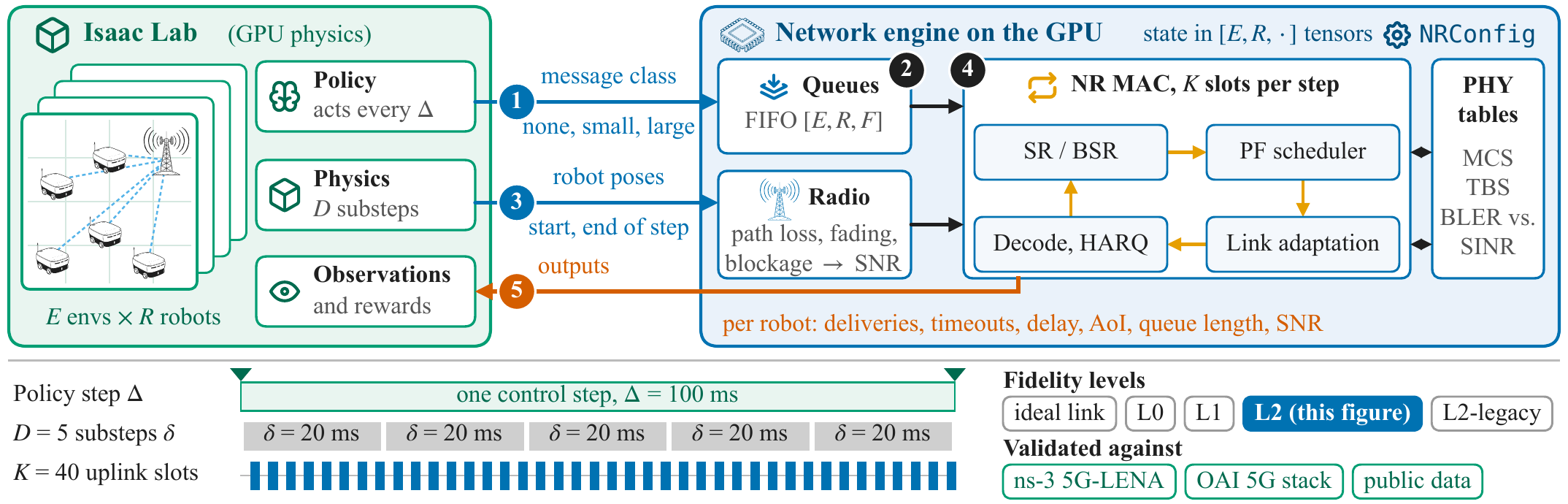
One 100 ms control step through Isaac-Net: message classes and robot poses go in, 40 uplink slots of the NR MAC run on GPU tensors, and per-robot deliveries, delay, AoI, queue length and SNR come out.
slot-synchronous
Time advances in NR slots
An Isaac Lab control step of 100 ms (physics at 1/50 s, decimation 5) covers 200 slots of 0.5 ms at 30 kHz subcarrier spacing. With the TDD pattern DDDSU, 40 of them are uplink. In each uplink slot the MAC handles scheduling requests and buffer reports, runs a proportional-fair scheduler, decodes transport blocks against a BLER table and schedules HARQ retransmissions, for every robot in every environment at once.
fixed-shape
No branches, no host round trips
Channels, HARQ processes, link-adaptation offsets and message queues are fixed-size tensors, for example a 16-frame FIFO [E, R, 16] per robot. Conditional logic is written as masks and selects, so a step allocates nothing and never waits on the CPU. That is what lets a CUDA graph replay the step and a single Triton kernel run all 40 slots in one launch.
lockstep
One network step per physics step
Frames are captured at the pose at the start of the step, and the network step consumes the end-of-step poses, so delay and age of information are counted exactly in control steps. Each environment keeps its own clock, and reset(env_ids) resets only the envs Isaac Lab ends. Envs that are not reset stay bit-for-bit unaffected.
Scope. The engine is an abstraction of the 5G stack, not a packet-level simulator. ns-3 co-simulation bridges (lockstep, process pool, offline replay) are in the package for validation only and are never needed for training.
What it models
Fidelity levels behind one call
Every level exposes the same API, so a task changes fidelity by changing one argument of make_engine. The two per-slot engines are the configurable NR engine L2 and the frozen prototype L2-legacy. Both have graph and triton backends.
Level
Model
Typical use
L0
i.i.d. lognormal delay and loss
the usual randomized-delay baseline
L0DR
L0 with per-episode randomized delay and loss
domain randomization
L05, L05Q
lookup tables fitted offline from L2 rollouts
cheap state-conditioned delay
L1
fluid slot model with equal PRB shares and FIFO queues
contention without MAC detail
L2
configurable NR MAC and PHY (below)
the fidelity model
L2-legacy
prototype per-slot MAC and PHY, frozen, multi-cell capable
reproducing prototype experiments, speed at scale
TR
trace replay of one recorded L2 env-episode per env, open loop
replayed-trace baseline
GE
3-state Markov-modulated delay and loss, one chain per env
Gilbert–Elliott-style baseline
QA
analytic processor-sharing queue per control step, FIFO service, SR delay
contention without slot simulation
NN
learned stateful surrogate: drop probability and delay quantiles from send-time features
learned-surrogate baseline
ORACLE
every message delivered at capture, delay 0
upper bound on what any network gives a task
NOCOMM
no message ever delivered
lower bound: the task without communication
NR features
Layer
Configurable NR engine (L2)
Prototype per-slot model (L2-legacy)
Radio
path loss, spatially correlated shadowing per env and cell, correlated Rayleigh fading per subband and link
the same, one cell at the arena corner by default
Frame structure
numerology 0 to 2, any bandwidth (38.101 NRB), any TDD pattern and special slot, RBGs per 38.214
TDD DDDSU at 30 kHz, 40 UL slots per 100 ms, 5 subbands of 10 PRBs
Access
periodic SR, grant delay, BSR, optional proactive grants
scheduling request, grant delay, buffer status reports
Scheduling
proportional fair per RBG (subband or wideband metric), retransmissions first
proportional fair over subbands, power split with a headroom cap
Link
3GPP MCS tables and exact TBS, EESM, BLER-target link adaptation, OLLA, MCS caps
OLLA, one transport block per robot per slot, logistic BLER on effective SINR
Retransmission
multiple HARQ processes, chase or IR combining, RLC AM retry or UM loss
HARQ with a chase-combining gain and a retransmission limit
Downlink
per-robot gNB queues, delayed and quantized CQI, K1 feedback
none
Cells
1 to 7 cells, PF scheduler and HARQ per cell, same-slot UL and DL interference, fractional UL power control, A3 handover with interruption
1 to 7 cells, same-slot UL interference, fractional power control, A3 handover
Application
per-robot FIFO, in-order completion, timeout or PDCP discard
per-robot FIFO of frames, in-order completion, 2 s application timeout
One NRConfig dataclass configures every module, with presets for the ns-3 5G-LENA reference scenario (lena_like, lena_validation), latency fitted to public srsRAN and OAI measurements (srsran_like, oai_like), and hexagonal multi-cell layouts (multicell(n)). lena_validation_v2() adds 5G-LENA's MAC behavior under load with no fitted parameter. The NR engine runs on the reference, graph and triton backends. triton does not yet implement the SR / BSR grant pipeline and runs v2 with a lumped 40-slot SR-to-grant delay instead.
Validation
Checked against ns-3, public traces and itself
5G-LENA alignment
≤ 1.2%
median p50 delay error against 5G-LENA at light, moderate and saturated load
The reference is stock ns-3.48 with 5G-LENA NR v5.1, changed only by a crash guard that does not alter any completed run. A 186-run uplink sweep covers 1 to 64 UEs, 4 KB and 30 KB frames, and 13–160% offered load, and the NR engine replays 153 runs on the same per-UE link budgets.
With 5G-LENA's MAC behavior under load in the engine (lena_validation_v2(), no fitted parameter), the median p50 delay error is −0.2%, −1.2% and −0.1% at light, moderate and saturated load, the median KS distance over the sweep is 0.17, and the median absolute p95 error is 3.5%. The configuration that runs at scale on triton stays at −3.5%, −5.7% and −0.8%.
In loaded cells the engine still drops 1.4–1.7 percentage points fewer frames than 5G-LENA. The engine defaults, NRConfig(), are not a validated configuration (median delay 30–76% low).
Public-data calibration
1.25 ms
Wasserstein-1 distance to srsRAN uplink latency after fitting
Uplink one-way delay from open 5G campus measurements (OAI and srsRAN) was fitted into the srsran_like and oai_like presets. ColO-RAN traces show the uncalibrated scheduler overestimates capacity by about 25–35% below saturation, and a capacity scale of 0.8 brings the error from 28% to 6%. POWDER drive tests place the 6 dB shadowing inside the measured range.
The latency fits rest on one UE, one bench channel and 35-byte packets. No public dataset has multi-UE NR uplink traffic or per-TB BLER, the capacity scale and a slower-decorrelating shadowing field are recorded as knobs but not applied in any preset, and the channel fits are outdoor campus drives.
Equivalence guarantees
bitwise
CUDA-graph backend vs the readable reference, every level and the NR engine
With the same random draws, the graph backend matches the eager reference with torch.equal on every output and every state tensor, over 300 steps and random partial resets, for the prototype levels and for the NR engine with downlink, three cells and traffic models. The fused triton kernel matches to rounding: from an identical state, 3 of 218,442 active NR robot-steps differ at 64 × 16. Inside Isaac Lab, the fleet env's network equals a reference replay of the recorded poses with zero difference.
Triton trajectories decorrelate in free-running mode, while delivered frames, mean delay and decoded TBs agree to 0.03% or better over 300 steps. The compile backend is unfit for training.
Results
Scale inside Isaac Lab
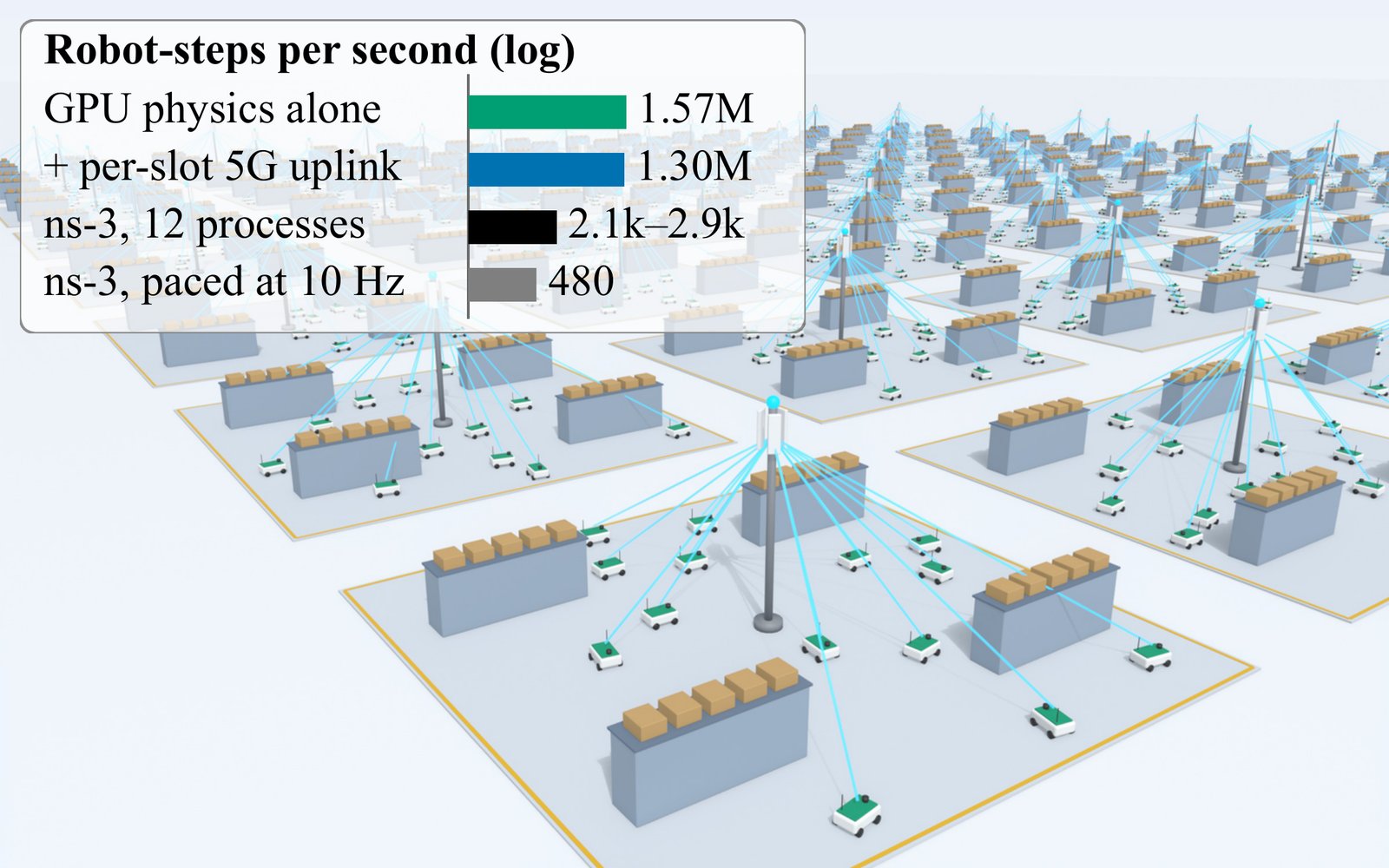
The paper's teaser: many arenas, each with its own gNB and robot fleet, stepped together on one GPU, with robot-steps per second against ns-3 co-simulation in the inset.
Control steps per second of the Isaac Lab fleet demo (Isaac Sim 6.1, Isaac Lab 3.0, PhysX, one idle RTX 4090) with random actions that saturate the uplink, the worst case for the network's cost. The NR engine runs the 5G-LENA-validated configuration on triton. Each bar is the mean of 3 processes, the ×-factor is network on divided by network off, and the right column is the isolated network time per step.
Key numbers
What
Measured
Context
Largest Isaac Lab run
8,192 envs × 128 robots = 1,048,576 robots at 1.24 control steps/s with the NR uplink vs 1.50 with the network off, 1.30 M robot-steps/s, 19.5 GiB device peak
NR engine on triton in its validated configuration, mean of 3 processes
Network step, 4,096 × 100
NR triton 94.4 ms per 100 ms of simulated time (67.8 ms with the engine defaults), L2-legacytriton 17.7 ms
409,600 robots, network only
Network step, 256 × 16
NR: reference 330 ms, graph 50.2 ms, triton 1.97 ms
uplink only, idle GPU
Against ns-3 co-simulation
at 524,288 robots, a control step with Isaac Lab and the NR uplink takes 0.41 s, about 83× less than Isaac Lab with ns-3 5G-LENA on 32 fully efficient CPU cores
different models: the cost of fidelity, not a like-for-like speed-up
Closed loop vs ns-3
mean AoI 0.583 vs 0.582 s, 0.515 vs 0.520 s and 1.023 vs 1.028 s at three loads
one fixed controller, 5 seeds (see below)
Software
pip-installable package, 690 CPU + 75 GPU tests, CI
BSD-3-Clause
All timings on an otherwise idle RTX 4090 (2026-09-30). Full tables are in the docs.
Closed loop
One fixed controller, every network model, three loads
A scripted Fleet-Alert controller runs unchanged against each network model, so the arms differ only in what the network delivers. Each robot sends a 30 kB camera frame when it has none in flight, and the offered traffic therefore depends on the network. The reference is ns-3 with 5G-LENA in lockstep, on a 60 m single-cell arena, 8 envs and 5 seeds of 30 s.
Load
Mean AoI, NR engine / ns-3 (s)
AoI p95, NR engine / ns-3 / i.i.d. delay (s)
Frames sent, NR engine / ns-3 / i.i.d. delay
light: 1 frame per 0.6 s, 8 × 16
0.583 / 0.582
0.86 / 0.90 / 0.80
6,393 / 6,386 / 6,394
1 frame per 0.2 s, 8 × 16
0.515 / 0.520
0.96 / 0.98 / 0.70
11,062 / 11,024 / 12,083
1 frame per 0.6 s, 8 × 32
1.023 / 1.028
2.00 / 1.94 / 1.30
11,235 / 11,353 / 11,864
The NR engine runs lena_validation_v2(). "i.i.d. delay" is level L0, a lognormal fitted to the NR engine's own delays at each load. Under load the i.i.d. model leaves the AoI tail 29–33% low and lets robots send 4.5–9.6% more frames, while the NR engine tracks ns-3. At 32 robots per cell the NR engine's median delay lies about 9% above that of ns-3. The task return is the same in every arm, the ideal link included, so the comparison rests on what the controller observes.
Isaac Lab quick start
Add a network to a DirectRLEnv in four hooks
Install.pip install torch (the CUDA build), then pip install isaac-net. Isaac Lab itself is installed separately; see the docs for the Windows and Linux paths.
python · Isaac Lab 3.0 DirectRLEnv
from isaaclab.envs import DirectRLEnv
from isaac_net import NRConfig
from isaac_net.isaac import NetEnvMixin, rigid_positions_local
class MyFleetEnv(NetEnvMixin, DirectRLEnv):
def _setup_scene(self):
... # self.robots: a RigidObjectCollection of R robots
self.net_setup("L2-legacy", R, NRConfig(msg_sizes=(4000.0, 30000.0)), backend="triton")
def _pre_physics_step(self, actions):
... # read the start-of-step pose, decide what to send
self.send = choose_messages(actions) # [E,R] long: 0 nothing, 1 small, 2 largedef _get_dones(self):
pos = rigid_positions_local(self.robots, self.scene.env_origins) # [E,R,3]
out = self.net_step(pos, self.send) # newest_cap, aoi_s, queue_len, delivered, ...
...
def _reset_idx(self, env_ids):
super()._reset_idx(env_ids); ...; self.net_reset(env_ids)
def _get_observations(self):
net = self.net_obs() # [E,R,4]: AoI, SNR, queued frames, delivered
...
net_setup takes any level of make_engine ("off" for an ideal link), an NRConfig, a backend and radio options. isaac_net.isaac.mdp.randomize_network is an EventTerm for network domain randomization.
python · the engine on its own, pure PyTorch
import torch
from isaac_net import Requests, make_engine

E, R, dev = 256, 16, torch.device("cuda")    # 256 envs, 16 robots each
net = make_engine("L2-legacy", E, R, dev, backend="graph")
pos = torch.rand(E, R, 2, device=dev) * 150
last = torch.full((E, R), -1, dtype=torch.long, device=dev)

for _ in range(300):    # one step = 100 ms = 40 UL slots
    send = (torch.rand(E, R, device=dev) < 0.3).long()
    net.submit(None, Requests(send))
    out = net.step(None, pos)
    last = torch.maximum(last, out["newest"])
    aoi = out["t"][:, None] + 1 - last    # age of information
    queued = out["queue_len"]
    done = torch.nonzero(torch.rand(E, device=dev) < 0.005).squeeze(-1)
    net.reset(done)    # partial reset, other envs untouched
    last[done] = -1
Tested with
Version
Isaac Sim
6.1.0.0 (pip wheels)
Isaac Lab
3.0 (release/3.0.0)
Python / PyTorch
3.12 / 2.12.0+cu130
Triton
triton-windows 3.8.0.post29
RL library
rsl-rl-lib 5.5.1
GPU
RTX 4090, Windows 11, driver 617.14
The engine alone runs on Linux with an NVIDIA GPU, and the reference engines also run on a CPU. Install steps are in the docs.
Roadmap
Where the engine stands
Early research prototype, packaged as isaac_net. State as of 2026-09-30.
donePer-slot uplink engine and the lower fidelity levels
donegraph backend, bitwise equal to the reference, and triton backend for scale, for the prototype levels and the NR engine
donePartial resets per env, per-env clocks and the submit / step dict API at every level and backend
@article{zhang2026isaacnet,
  title   = {Network-in-the-Loop at Scale: GPU-Batched 5G Simulation
             for Massively Parallel Robot Learning},
  author  = {Zhang, Zifan and Han, Mingzhe and Athreya, Kannan and Liu, Yuchen},
  journal = {arXiv preprint arXiv:2610.02370},
  year    = {2026},
  note    = {Zifan Zhang and Mingzhe Han contributed equally}
}
Contact
Get in touch
For collaboration or repository access, write to Zifan Zhang:

 one GPU